
Towne Bank Building, 984 First Colonial Rd Ste 300 Virginia Beach, VA 23454

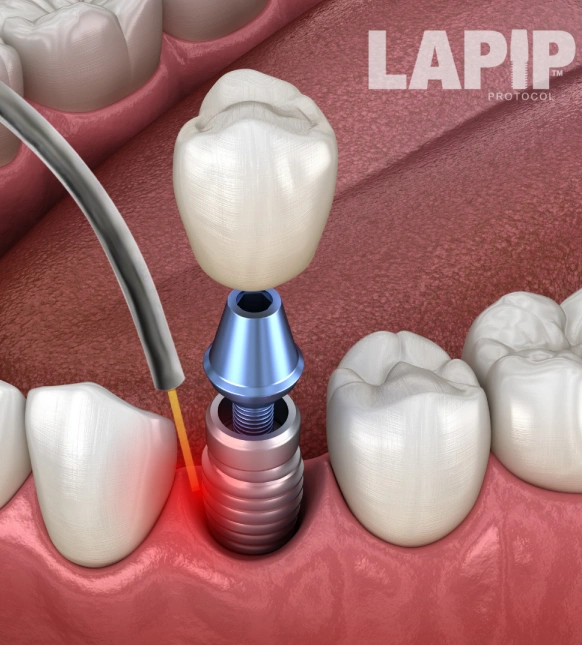
Laser Assisted Perio-Implantitis Procedure
The last 20 years has seen a revolution in dentistry, particularly in the field of dental implants. Gone are the days where patients have to suffer with loose fitting dentures and removable partials that cause damage to adjacent teeth. Dental Implants are here to stay and are overwhelmingly successful when placed and restored by experienced Dentists and Dental Surgeons.
Despite our best efforts, we are seeing more and more complications with implants. This is a condition we call “Peri-Implantitis”. Many times, implants can get infected under the gum line, which can result in bone loss around the implant, and in some cases loss of the implant itself. Complications due to systemic disease, medications and simply enough, aging can all lead to this problem.
Until recently, the only treatment for an “ailing” implant was either extensive surgical repair and in most cases, removal of the implant and waiting for a new one to be placed.
FDA-Cleared Treatment for Peri-Implantitis
With the advent of LAPIP, which is a specific laser surgery procedure (does not involve a scalpel or stitches), we are able to treat the infections and arrest the disease, and in some cases regenerate new bone around the implant itself!
LAPIP — which stands for Laser Assisted Peri-Implant Procedure, is the only FDA cleared laser procedure to treat ailing dental implants.
Why Peri-Implant Disease Develops
The implant itself cannot decay or become diseased. The tissue holding it in place can.
Peri-implant disease follows almost the same path as gum disease. It begins as peri-mucositis, a mild inflammation of the soft tissue surrounding the implant. At that stage the bone is untouched and the condition is reversible. Left alone, the inflammation moves deeper. Bone around the implant begins to erode, the seal between tissue and implant breaks down, and the implant loses the support that was holding it steady.
Several things can start that first inflammation:
- Periodontal bacteria already present elsewhere in the mouth
- Cement, food debris, or other material trapped in the tissue around the implant
- An implant connector or abutment that does not seat correctly
- Inconsistent home care or missed hygiene visits
- Grinding and clenching that overloads the implant
- Health factors such as diabetes, osteoporosis, a weakened immune system, or tobacco use
Patients who had gum disease before their implant was placed carry a higher risk of implant loss, which is why we monitor implant tissue closely at every recall visit.
Signs Your Implant May Be in Trouble
Peri-implantitis is often quiet in its early stages, which is part of what makes it dangerous. Call our Virginia Beach office if you notice any of the following around an implant:
- Swollen or puffy gum tissue
- Bleeding when you brush or floss near the implant
- A color change in the gums, usually darker red or purple
- Tenderness or heightened sensitivity at the implant site
- Gum recession that exposes more of the implant or crown
- Pus or discharge from around the implant
- Aching, throbbing, or sharp pain near the implant
- Any movement or looseness in the implant
Movement is the most urgent of these. If an implant feels loose, do not wait for your next scheduled visit.
What the LAPIP Protocol Accomplishes
The goal of LAPIP is not simply to clean the pocket. It is to change the environment around the implant so healing can happen. Treatment works to:
- Halt the progression of peri-implant disease
- Eliminate the bacteria driving the inflammation
- Preserve healthy gum tissue instead of cutting it away
- Support the regeneration of bone around the implant
- Maintain the height of the tissue surrounding the implant
- Seal the pocket so bacteria cannot recolonize it
Because nothing is cut and no foreign material is introduced, LAPIP is considered a first-line treatment. If it does not fully resolve the problem, every other treatment option remains open to you.
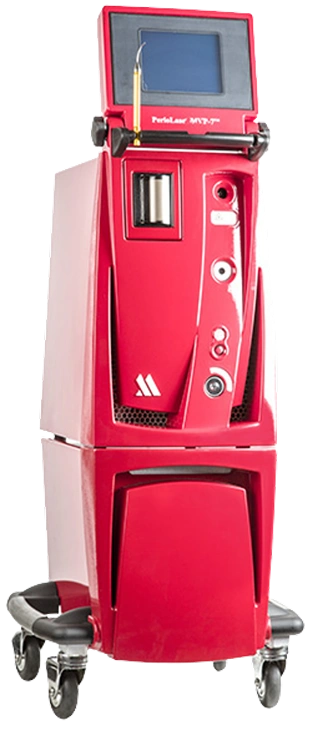
The PerioLase MVP-7 Laser
The LAPIP protocol is performed with the PerioLase MVP-7, a dental laser built specifically for periodontal and peri-implant treatment. Its wavelength is selective. It targets pigmented bacteria and diseased tissue while leaving healthy tissue intact, which is what allows the procedure to be done without a scalpel or sutures.
The same wavelength is also safe around titanium, so it removes bacterial contamination and titanium corrosion byproducts from the soft tissue without damaging the implant surface itself.
What to Expect at Your Appointment
LAPIP is performed in our Virginia Beach office using local anesthetic, and in many cases it can be completed at the same visit as your diagnosis.
Depending on the implant design, we may remove the implant crown to gain proper access to the site. Once the area is cleaned, a laser fiber roughly the width of three human hairs is guided gently into the infected space around the implant. That fiber is the entire access point. There is no incision and no suturing.
Before we begin, our team walks you through every stage of the procedure and answers your questions. Most patients return to their normal routine the same day or the next.
Are You a Candidate for LAPIP?
LAPIP is intended for patients with an existing dental implant showing signs of peri-mucositis or peri-implantitis. Candidacy depends on how much bone has already been lost and whether the implant remains stable enough to save.
Diagnosis begins with a clinical exam, periodontal probing around the implant, and imaging to assess bone levels. From there we can tell you honestly whether the implant can be saved or whether removal and replacement is the more predictable path. Earlier evaluation almost always means more options.
LAPIP Post-Operative Instructions
LAPIP Testimonials by Patients and Other Doctors
Frequently Asked Questions About LAPIP Laser Treatment
Trust Us for Your Periodontal Needs!
Dr. Cavallari provides a variety of surgical services for the treatment of periodontal issues. Contact us for more information.
